
Chapter 01
History of Billiards
Six centuries from lawn game to precision sport.
Origins
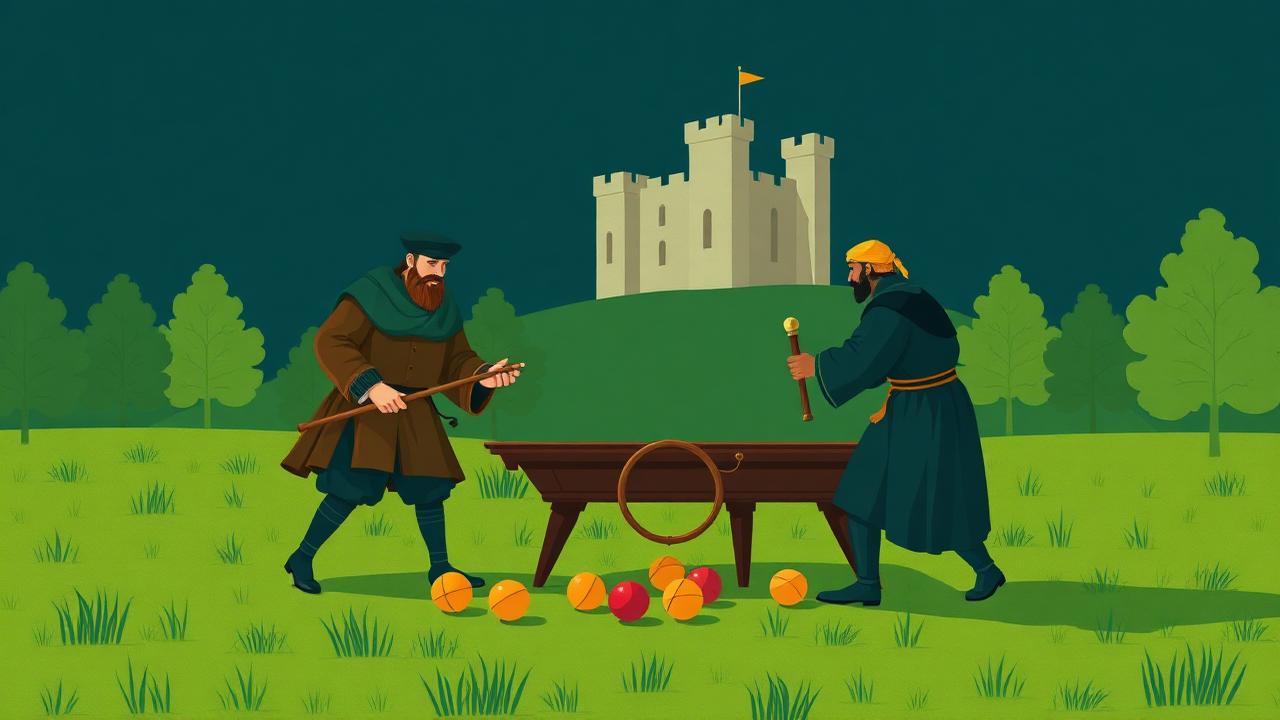
Billiards began as an outdoor lawn game in 15th-century Northern Europe — closer to croquet than to what we play today. It moved indoors onto a table with a green cloth mimicking grass, and players pushed balls with a mace. The word "cue" comes from the French queue, meaning tail — the thin end of the mace, used when the ball sat against a rail.
Key milestones
- ~1470 — first written references in French royal accounts.
- 1600s — rails ("banks") added to keep balls on the table.
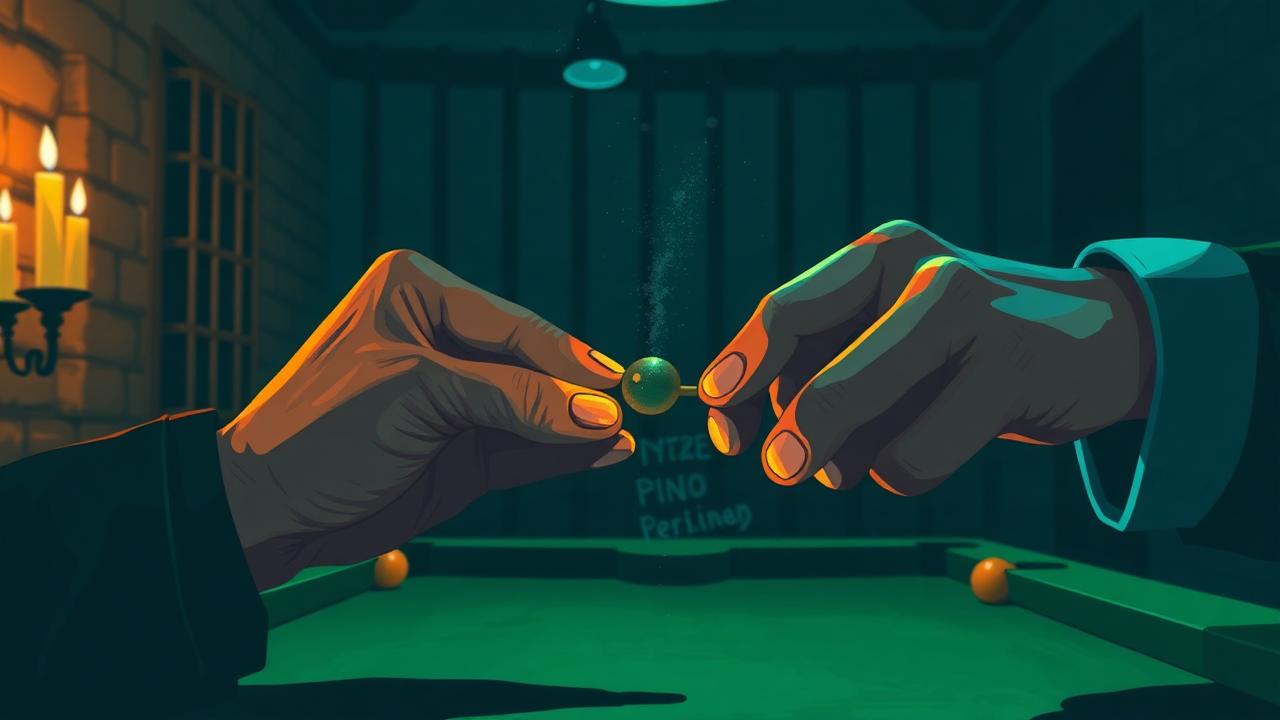
- 1807 — François Mingaud invents the leather cue tip in a Paris prison, unlocking spin.
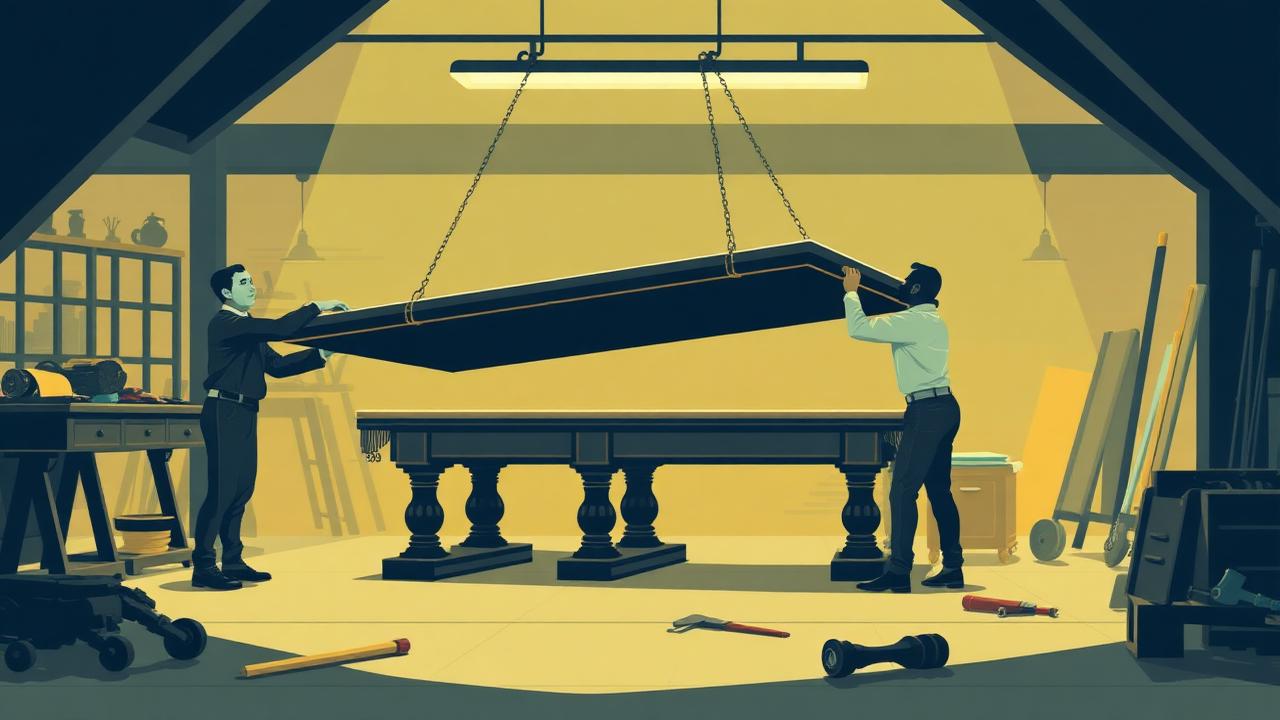
- 1826 — John Thurston builds the first slate-bed table.
- 1869 — vulcanized rubber cushions replace cloth-stuffed rails.
- 1920s — 8-ball emerges in the United States as a bar-room evolution of pyramid pool.
From ground game to green baize
The earliest documented reference to a stick-and-ball lawn game appears in the household accounts of King Louis XI of France around 1470, listing payment for a "billart" table and cloth. The name itself likely derives from either the French bille (a wooden stick or ball) or billart, an early term for the wooden cue-stick used to push balls through hoops set into a lawn, much like croquet. Within a century the game had migrated indoors: raised wooden tables covered in green wool cloth recreated the grass, timber rims kept the balls from rolling onto the floor, and a low retaining lip eventually became the cushion. Mary, Queen of Scots, complained in an imprisonment letter of 1586 that her billiard table had been taken from her — evidence the game had already become a fixture of European aristocratic life a full century before it reached ordinary taverns.
Shakespeare references billiards in Antony and Cleopatra (circa 1606), when Cleopatra invites her attendant Charmian to "play billiards" — an anachronism for ancient Egypt, but proof the game was common enough in Elizabethan England for audiences to recognize instantly. By the 1600s the mace — a long-handled, broad-faced pushing implement resembling a small croquet mallet — was standard equipment. Players stood to the side of the ball and shoved it, an awkward posture when the ball lay tight to a rail. The solution was to flip the mace around and strike with its narrow tail end. That tail, called the queue in French, is the direct linguistic ancestor of the modern word "cue," first recorded in English texts around 1717.
The cushion and the birth of spin
Early rails were simply raised wooden edges, later padded with stuffed cloth or rope to soften ball rebound; the word "bank" for a cushioned rail survives today in "bank shot." Rubber compounding did not exist yet, so rebounds were inconsistent and dead in cold weather, lively in warm — a real competitive variable innkeepers had to manage by keeping their billiard rooms heated. The single most transformative invention in the sport's history arrived in 1807: François Mingaud, a French artillery captain imprisoned during the Revolutionary period, experimented with leather cue tips while confined, and upon release petitioned for permission to stay longer specifically to continue his research. Before Mingaud, cues ended in flat wood or bare ivory, which slid off the ball on anything but a dead-center hit. A leather tip grips the cloth of the ball microscopically on contact, which is what allows a cue tip struck off-center to impart rotation — draw, follow, and side ("English") all became possible for the first time. Every stroke technique taught in this manual, from stun shots to swerve, exists only because of Mingaud's leather tip.
Chalk followed logically: without a roughened, tacky tip surface, off-center hits still miscue. Players initially used generic chalk blocks; the modern pressed cube dates to the mid-1800s and was popularized commercially by the Brunswick-Balke-Collender Company in the United States.
Slate, ivory, and the industrial table
John Thurston, a London cabinetmaker who had trained under billiard-table builder William Gibb, patented the slate bed in 1826. Wooden beds warped with humidity and temperature, throwing off roll almost immediately after installation; quarried slate, precisely leveled, holds flatness to a fraction of a millimeter for decades. Thurston tables also introduced rubber cushions after Goodyear's 1839 vulcanization process made rubber stable and elastic rather than brittle or gummy — commercialized in billiard cushions by roughly 1845 and standard by 1869. Balls themselves were carved from elephant ivory well into the 20th century, a practice that drove significant ivory demand and, combined with supply shortages, spurred an 1868 contest (sponsored by Phelan & Collender) offering $10,000 for a synthetic substitute. Chemist John Wesley Hyatt's resulting experiments with nitrocellulose led directly to celluloid, one of the first synthetic plastics, though it was volatile and occasionally reported to spark or even mildly detonate on hard collisions. Phenolic resin balls (the ancestor of today's polyester/phenolic blends) replaced celluloid by the 1920s and remain the basis of modern ball manufacture, typically Aramith's phenolic resin balls used in professional play today.
Practice note
Understanding this timeline is not trivia — it explains why the equipment behaves the way it does. Slate is flat because Thurston made it flat; your ball glides true because Goodyear's rubber returns energy consistently; you can put spin on the ball at all because a French prisoner glued leather to a stick. Next time you chalk your tip, that motion connects you to a specific 1807 innovation rather than an arbitrary ritual.
The rise of 8-ball
8-ball is now the most-played cue sport on Earth. It is the standard game in bars, homes, and amateur leagues worldwide, and the discipline governed by the World Pool-Billiard Association (WPA) alongside 9-ball and 10-ball.

Its dominance comes from balance: enough strategy to reward the expert, enough randomness at the break to keep beginners in the game. Every skill in this manual — stance, stroke, position play, safety — sharpens the exact same shot the beginner is already trying to make.
From pyramid pool to 8-ball
8-ball's direct ancestor is "Pyramid Pool," an English game from the mid-1800s played with fifteen red balls racked in a triangle and one cue ball, the object simply being to pocket as many reds as possible. American variants added colored balls for identification and scoring around the 1900s. The specific solids-and-stripes, first-to-clear-your-group-then-the-8 format we call "8-ball" (originally "B.B.C. Co. Eight Ball," named for the Brunswick-Balke-Collender Company) is documented in American rulebooks by around 1925. It spread rapidly through Prohibition-era pool halls precisely because it required no scorekeeper, no chalkboard, and no umpire — two players could settle the entire contest by eye, which made it ideal for the fast, informal, often wagering-heavy atmosphere of speakeasies and bar rooms.
Governance and standardization
For most of the 20th century, rules varied town to town — some rooms played "win the lag" as sole break rights, others rotated the break; some spotted a scratched 8-ball, others called it a loss outright. Standardization arrived through several competing bodies. The Billiard Congress of America (BCA), founded in 1948, published widely adopted amateur rules. The World Pool-Billiard Association (WPA), formed in 1987 as the international federation recognized by the World Confederation of Billiard Sports, now issues the rulebook most tournaments reference, including the WPA World Eight-ball Championship. A separate, historically distinct code — "English 8-ball pool" or "blackball" — is governed in the UK and much of Europe by the World Eightball Pool Federation (WEPF) and uses a smaller 2-inch ball set on a table with pockets cut noticeably tighter than American 9-foot equipment, along with different foul consequences (such as two shots to the opponent after certain fouls). A player who learns on a UK-style blackball table and then switches to WPA rules must consciously relearn foul penalties and pocket sizes; the fundamental cue mechanics transfer completely, but not the rulebook.
Why 8-ball became the default
Several structural features explain its universal adoption over rivals like straight pool (14.1 continuous) or English snooker. First, equipment cost: a 7-foot bar box with a coin mechanism pays for itself through casual play in a way a 12-foot snooker table, requiring a dedicated room, cannot. Second, game length: an 8-ball rack typically resolves in 5–15 minutes, matching the attention span and turnover expectations of a commercial bar. Third, accessibility: a beginner can pocket a ball on their very first turn, whereas straight pool's opening break intentionally avoids pocketing anything, and snooker's colored-ball sequencing takes hours to internalize. This blend of low barrier to entry and high strategic ceiling — position play, safety exchanges, pattern planning — is what separates 8-ball from a purely luck-based bar game and is why it supports genuine professional competition, including events such as the WPA World Eight-ball Championship (first held in its current international format in the 1990s) and major American amateur leagues like the APA (American Poolplayers Association, founded 1979) and BCAPL, both of which run handicapped formats allowing players of widely different skill levels to compete on equal footing through a numerical rating system.
Notable figures and the professional lineage
While 9-ball has historically drawn more professional prize money and television coverage, several players built reputations specifically in 8-ball. Efren Reyes, the Filipino player nicknamed "The Magician," is frequently cited by peers as the greatest all-around pool player in history precisely because of his mastery of position and safety play — skills that translate directly to 8-ball strategy even though he competed across disciplines. On the American amateur circuit, the APA's structure — over 250,000 members at its peak — did more than any single tournament to cement 8-ball, rather than straight pool or 9-ball, as the default social version of the sport in the United States.
Continuity of technique
The throughline from a 15th-century mace push to a modern stop-shot is unbroken: every rule change in 8-ball's history — call-shot requirements, ball-in-hand penalties, re-spotting the 8 after an early pocket — exists to reward accuracy and punish sloppy contact, the same values a lawn-game hoop-shot rewarded five centuries ago. When you drill a stun shot or a two-rail kick today, you are practicing the same underlying skill — precise, repeatable cue-ball control — that has been the entire point of this family of games since balls first rolled across grass.