
Chapter 14
Visual Academy: Aiming & Spin
Ten illustrated studies, from ball overlap to controlled position.
Fractional aiming
Fractional aiming
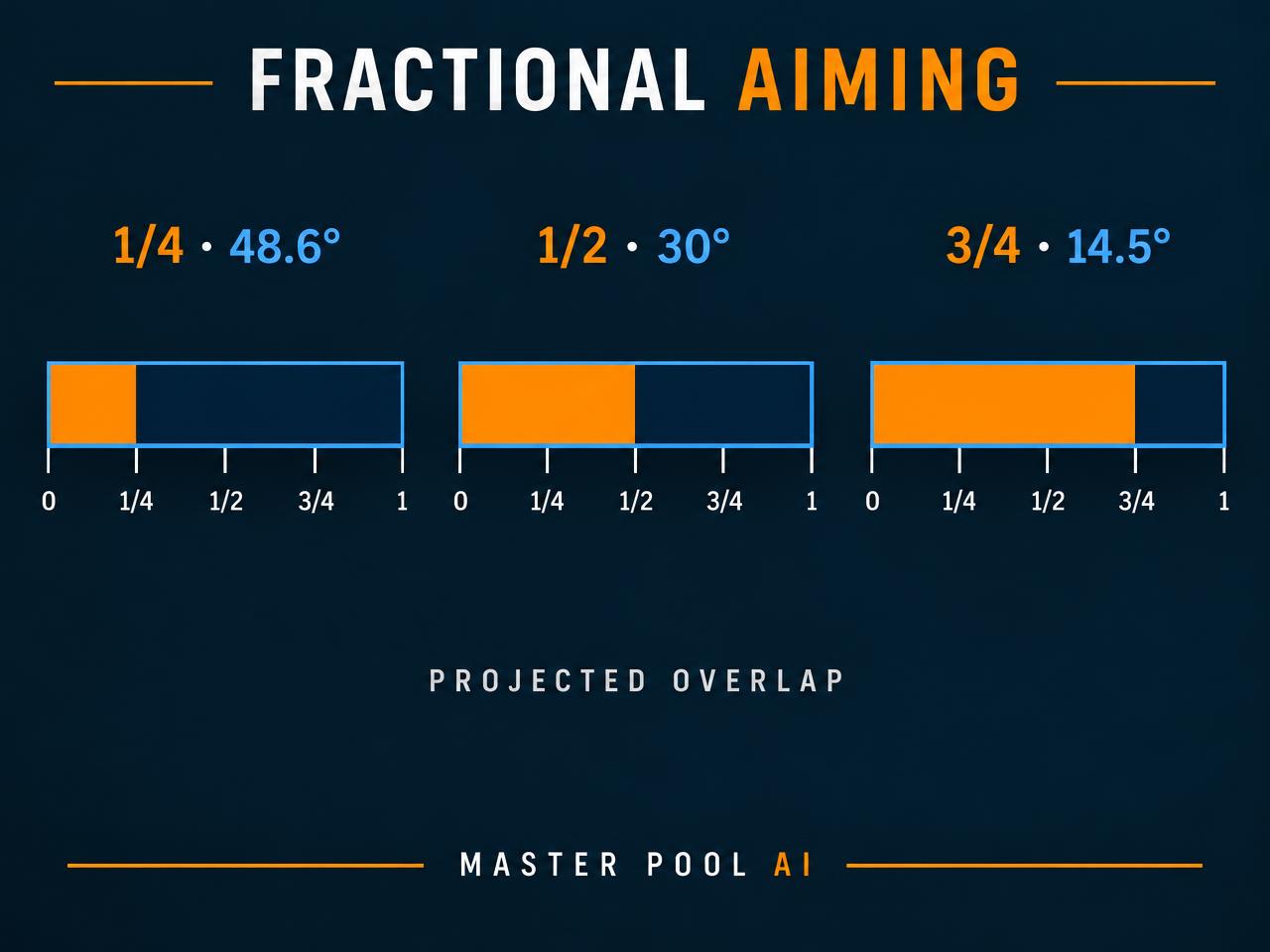
A full hit aligns the centers. A half-ball hit aims the cue-ball center toward the visible object-ball edge. A thinner overlap produces a larger cut. Fraction means overlapping width as seen along the incoming line, not overlapping area. Equal-sized balls obey cut angle = arcsin(1 − overlap), before throw.
These are geometric references, not guaranteed potting lines. Throw, perspective, ball size and delivery change the real shot.
Real-table practice
Set an easy object ball one diamond from a corner. Mark three cue-ball positions giving 3/4, 1/2 and 1/4 hits. Play five shots from each position without sidespin, reset exactly, and record left/right misses.
Overlap → cut angle
50.0% overlap · 30.0° cut
Ideal equal-ball geometry, before throw. Width overlap, not area.
| Hit fraction | Cut angle |
|---|---|
| Full | 0.0° |
| 7/8 | 7.2° |
| 3/4 | 14.5° |
| 5/8 | 22.0° |
| 1/2 | 30.0° |
| 3/8 | 38.7° |
| 1/4 | 48.6° |
| 1/8 | 61.0° |
The cue-tip clock
The cue-tip clock
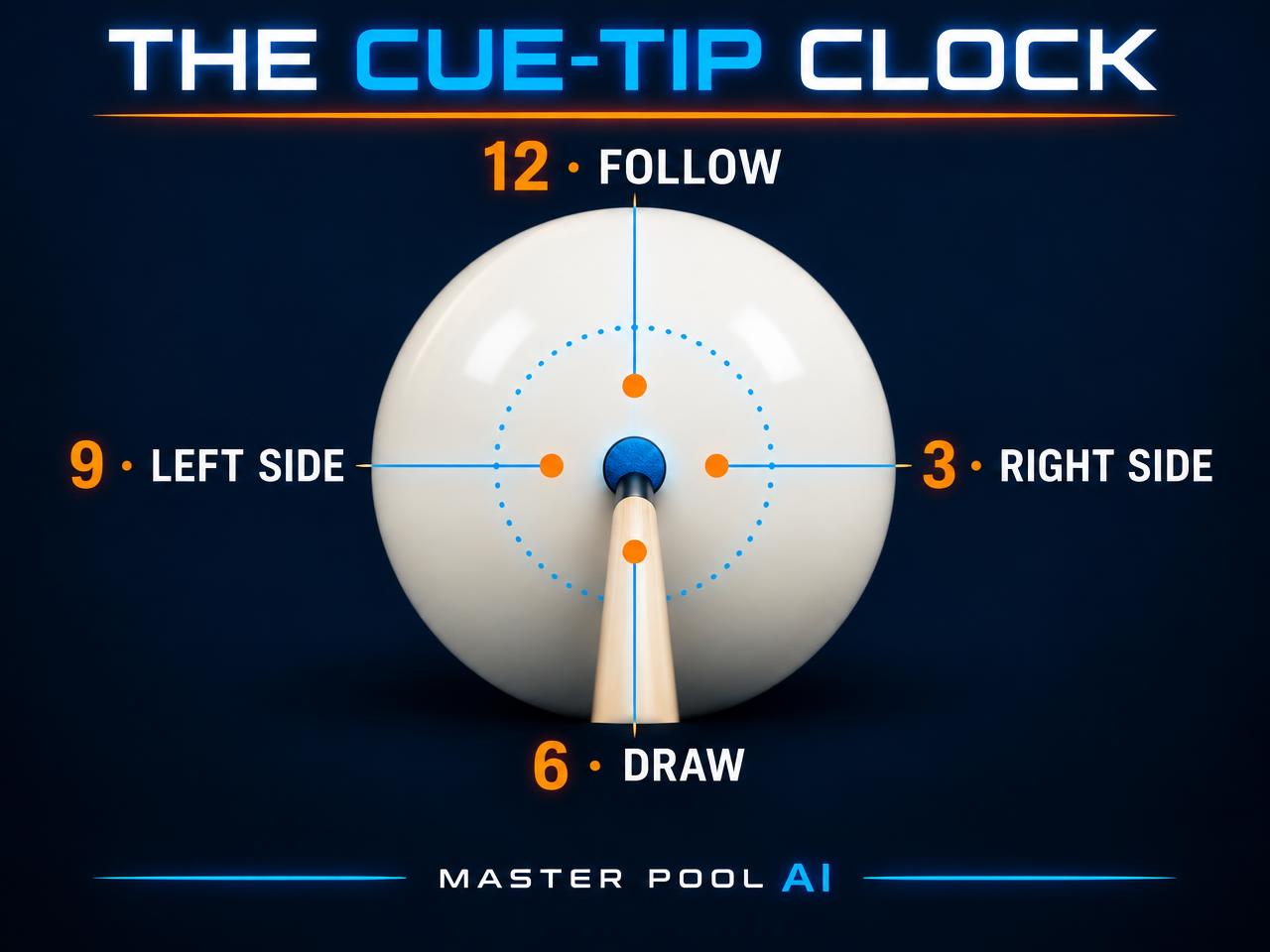
The tip clock describes WHERE you hit the cue ball, not the cut angle. Twelve adds forward rotation, six adds backspin, three adds right sidespin, and nine adds left sidespin. Diagonal positions combine vertical and side rotation.
A clock position specifies direction, not tip offset. Begin close to center; never use the ball edge as a strike target.
Real-table practice
Use a short straight pot. Shoot five modest high hits and five modest low hits with a nearly level cue. Compare where the cue ball finishes before adding any side.
The cut-angle clock
The cut-angle clock
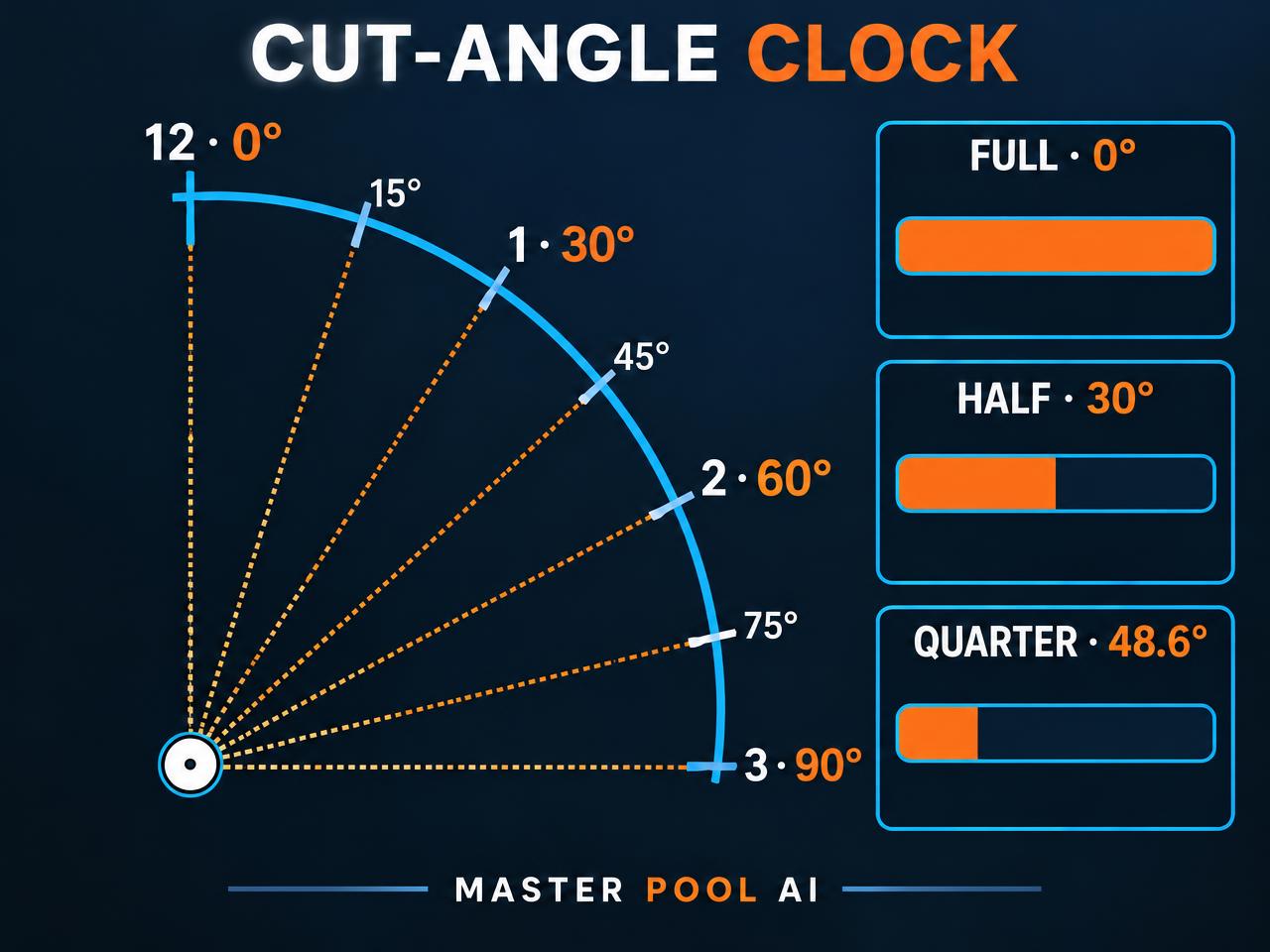
One hour on a clock is 30°. With the incoming line at twelve, twelve-thirty is 15°, one is 30°, one-thirty is 45°, two is 60°, two-thirty is 75°, and three is 90°. Mirror the clock for cuts to the other side.
Three-quarter is about 14.5°, not exactly 15°; quarter-ball is about 48.6°, not 45°. A 90° grazing limit has no useful full contact.
Real-table practice
From above the table, identify the incoming line and object-to-pocket line on five shots. Estimate the angle using the clock, then compare it with the fraction table before shooting.
Tip offset and the miscue boundary
Tip offset and the miscue boundary
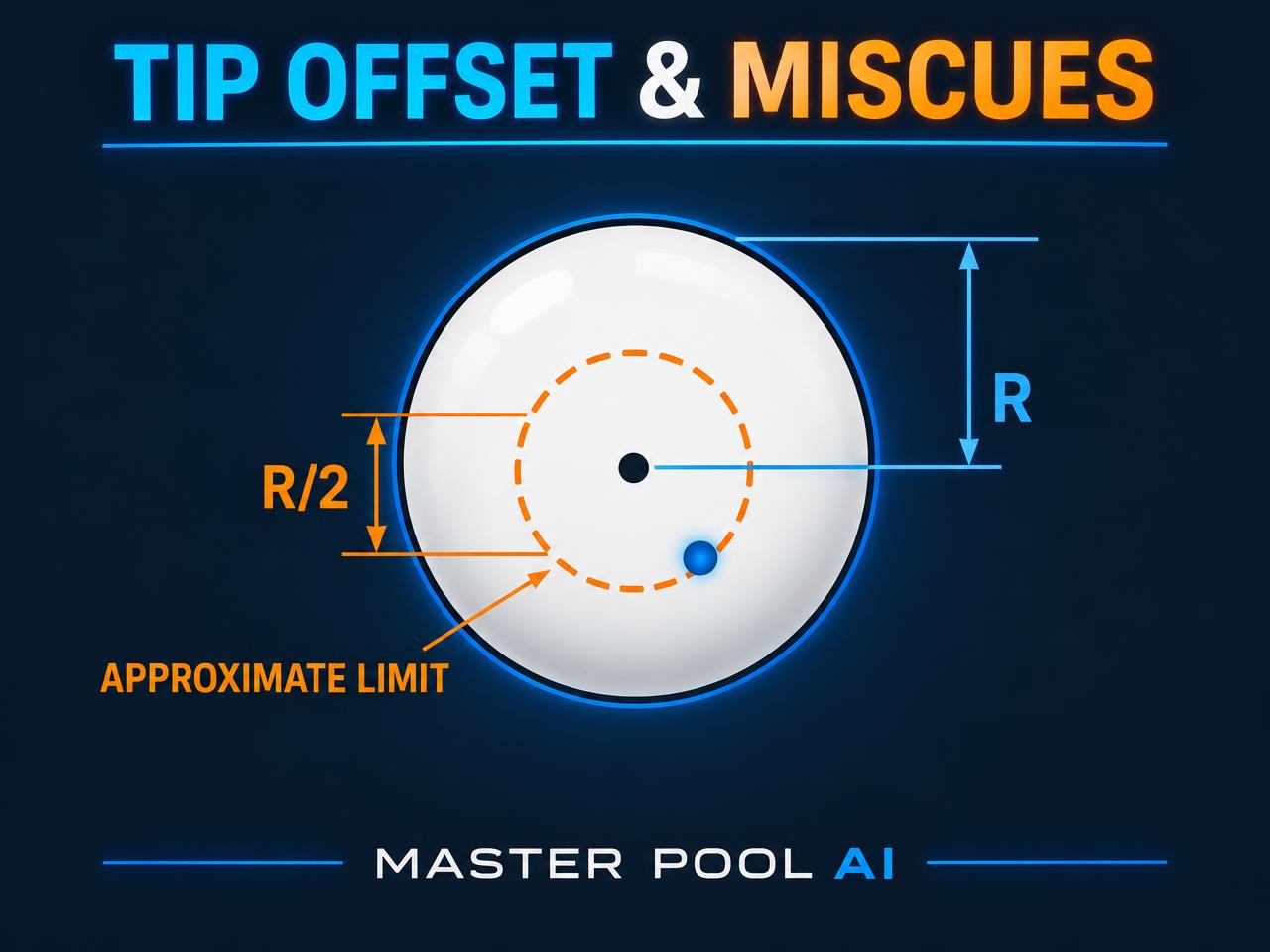
Tip offset is the distance from the cue-ball center to the contact point, viewed from behind the cue. Half the ball radius is a rough outer guide for substantial spin, not half the diameter. With combined side and vertical spin, the total radial offset matters.
Chalk, tip curvature, tip condition, elevation and delivery affect miscues. Stay comfortably inside the guide and never deliberately chase its edge.
Real-table practice
Chalk the tip and use a marked practice ball. Start near center on a short straight shot. Increase low-tip offset only a little at a time; reset after each shot and stop increasing if contact slips.
Squirt versus swerve
Squirt versus swerve
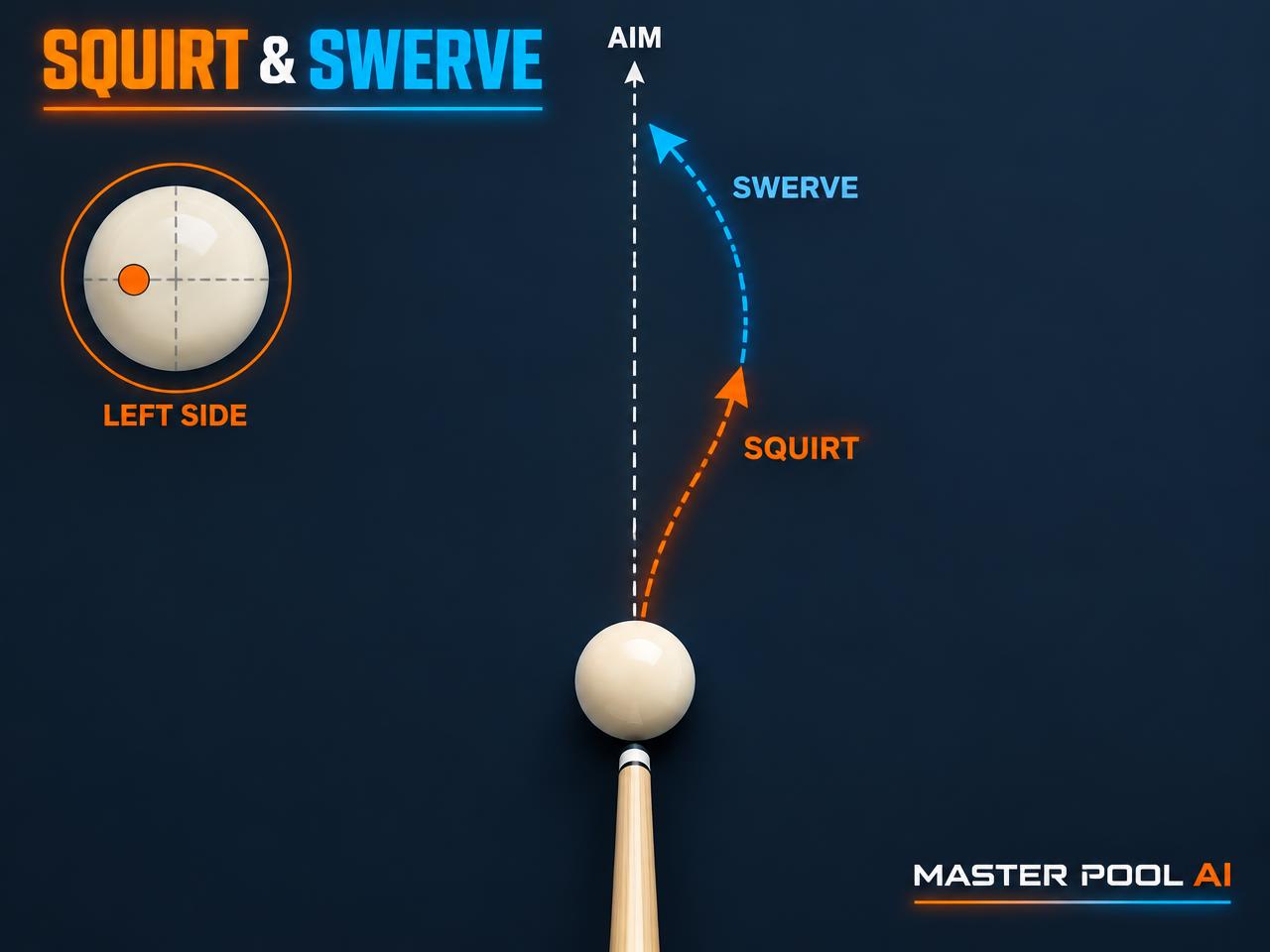
Squirt is the initial deflection opposite the side-tip offset. Swerve is the later curve associated with spin, cloth contact and cue elevation. With left sidespin, the cue ball initially deflects right and can curve back left. Right sidespin mirrors this.
Net aim depends on distance, speed, elevation, cloth and shaft. Slower travel gives swerve more time; never compensate by one universal angle.
Real-table practice
On a clear table, compare center, modest left and modest right hits along the same diamond line at the same speed. Keep the cue nearly level. Repeat farther away and note the endpoint; do not change multiple variables together.
Ball-hit fractions and exact angles
Ball-hit fractions and exact angles
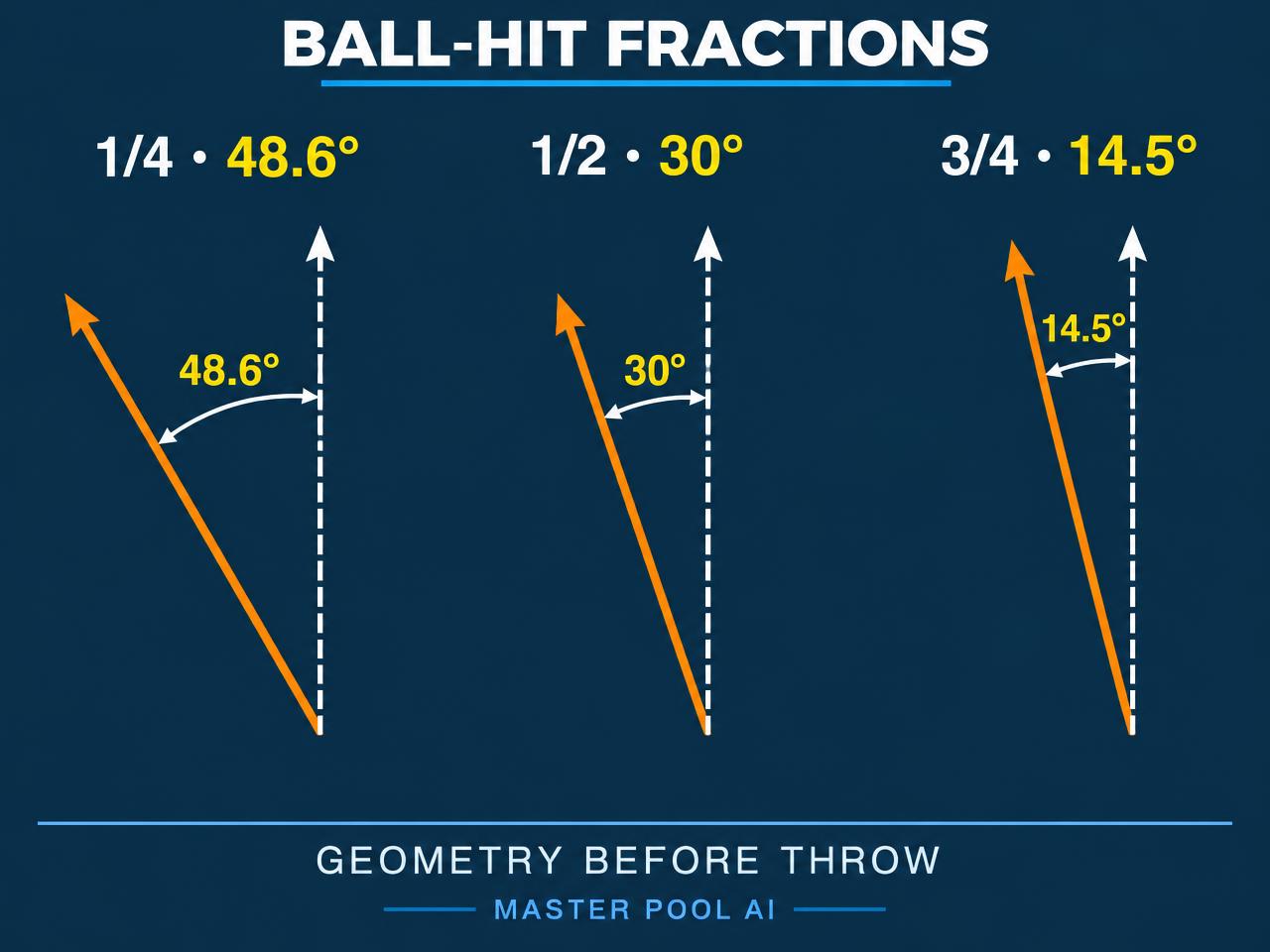
The cut is the angle between incoming cue-ball travel and outgoing object-ball travel. For equal balls without throw, the line joining their centers at contact determines the object-ball direction. Smaller overlap increases the angle.
Do not reuse the numerical throw tables from the screenshots as universal corrections. Their conditions are not fully specified.
Real-table practice
Build a half-ball shot and mirror it left/right. Play ten pots each way at consistent medium speed. Compare the two sides, keeping the cue level and avoiding side.
Overlap → cut angle
50.0% overlap · 30.0° cut
Ideal equal-ball geometry, before throw. Width overlap, not area.
| Hit fraction | Cut angle |
|---|---|
| Full | 0.0° |
| 7/8 | 7.2° |
| 3/4 | 14.5° |
| 5/8 | 22.0° |
| 1/2 | 30.0° |
| 3/8 | 38.7° |
| 1/4 | 48.6° |
| 1/8 | 61.0° |
Ghost-ball aiming
Ghost-ball aiming
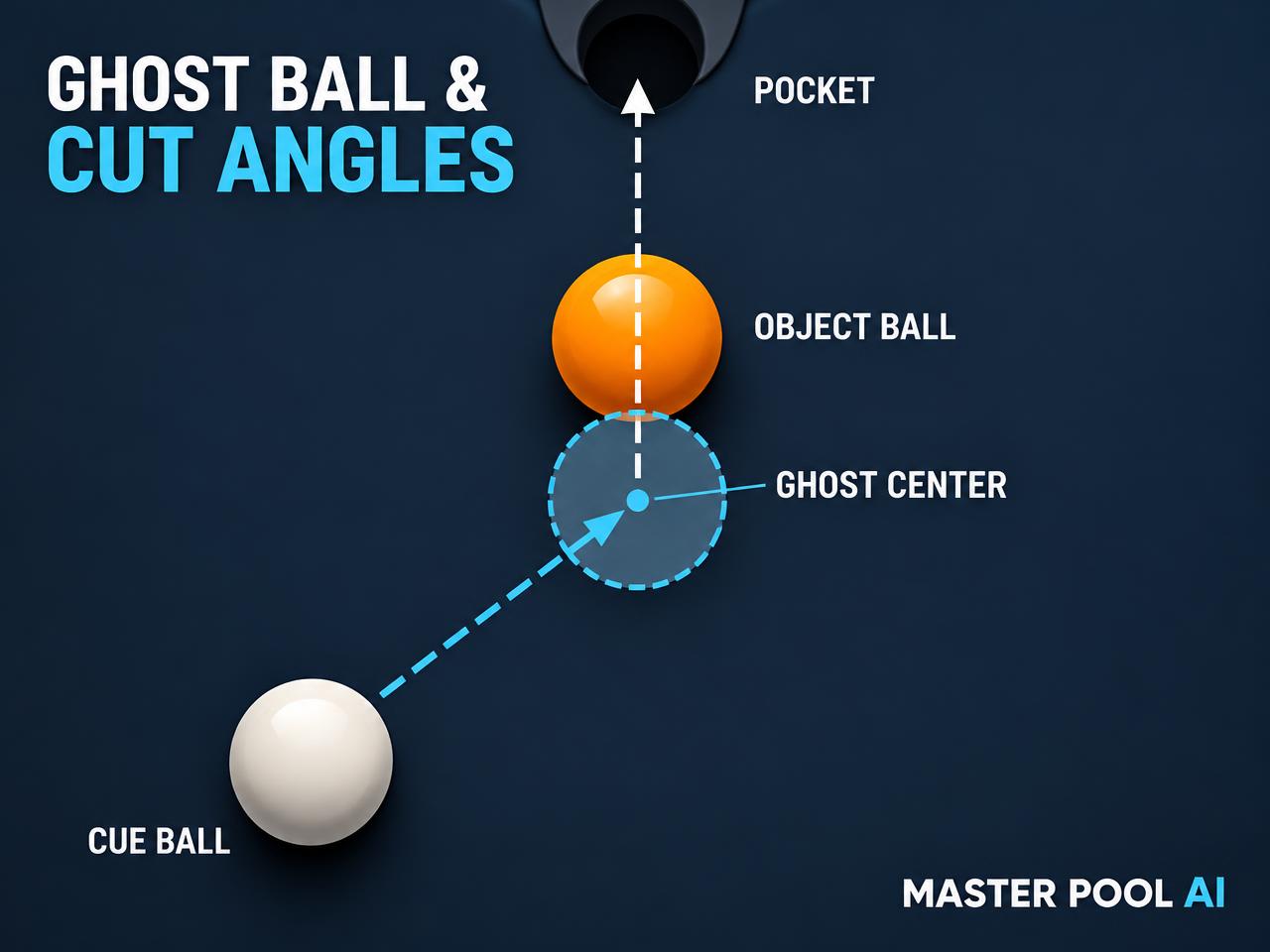
Choose the pocket entry point and draw a line from it through the object-ball center. Imagine an equal-sized cue ball touching the object ball on the far side of that line. Its center is one full ball diameter from the object center. Aim your real cue-ball center toward this ghost center.
The object’s contact point is not the cue-ball center’s aim point. Ghost-ball geometry does not automatically compensate for throw.
Real-table practice
Before a short cut, place a spare cue-sized ball at the ghost location to visualize the center. Remove it before playing. Repeat from both sides, then repeat without the spare ball.
Collision-induced throw
Collision-induced throw
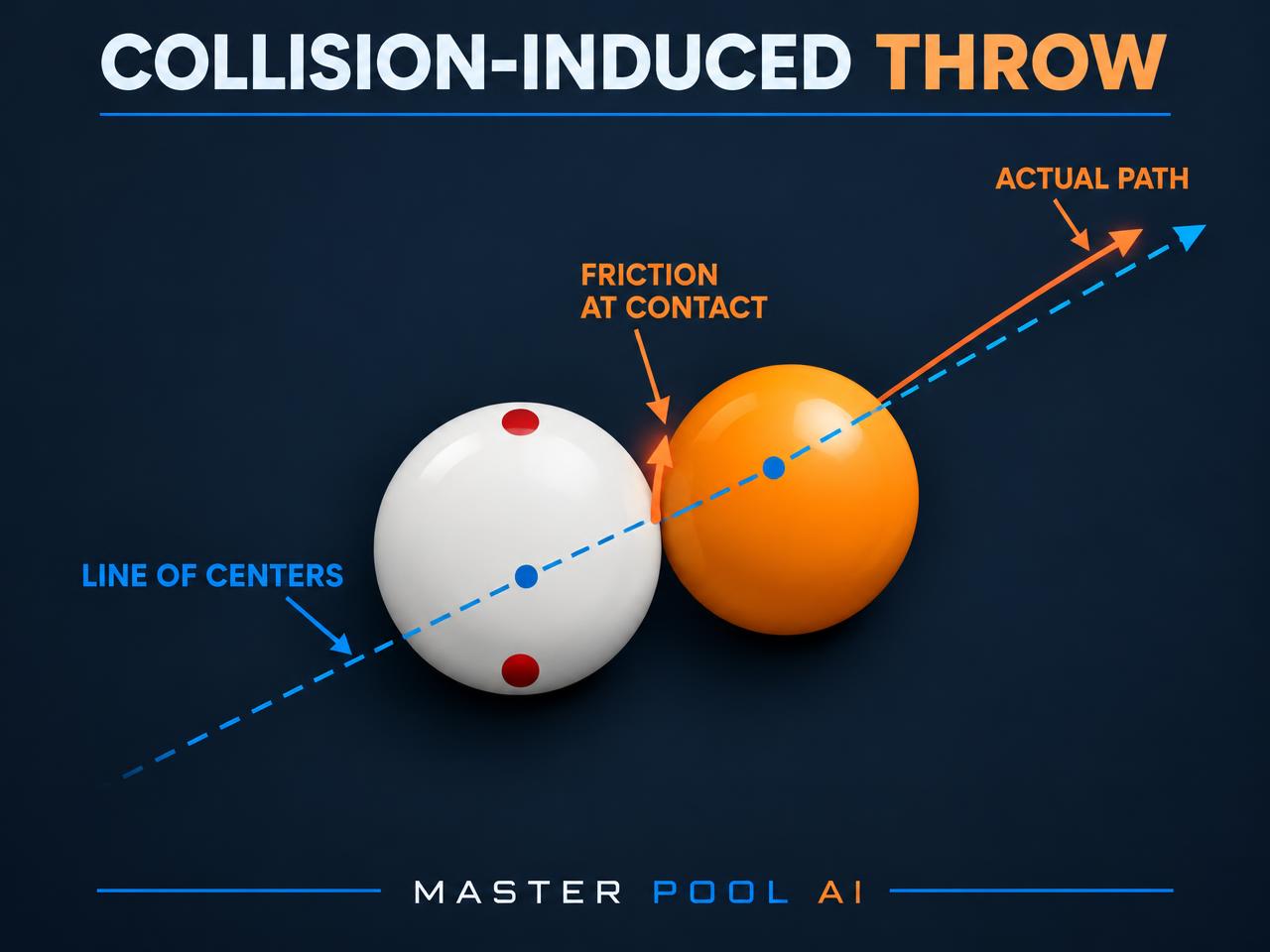
When balls slide sideways against each other at contact, friction can alter the object-ball direction. This is collision-induced throw (CIT). For stun shots, throw is often greatest around a half-ball cut; at slower speeds the maximum can shift toward thinner cuts. Spin-induced throw is a related but distinct effect.
Throw depends on cut, speed, spin and ball cleanliness. Faster cuts and rolling/drawing contact generally reduce CIT compared with slow stun, but no fixed degree correction works everywhere. Do not add sidespin blindly.
Real-table practice
Mark a repeatable half-ball cut. Compare five slow and five firmer center-axis shots, then a rolling version. Reset precisely and record which side misses. Keep the cue level and do not infer a universal correction from one set.
Follow, draw, stun and stop
Follow, draw, stun and stop
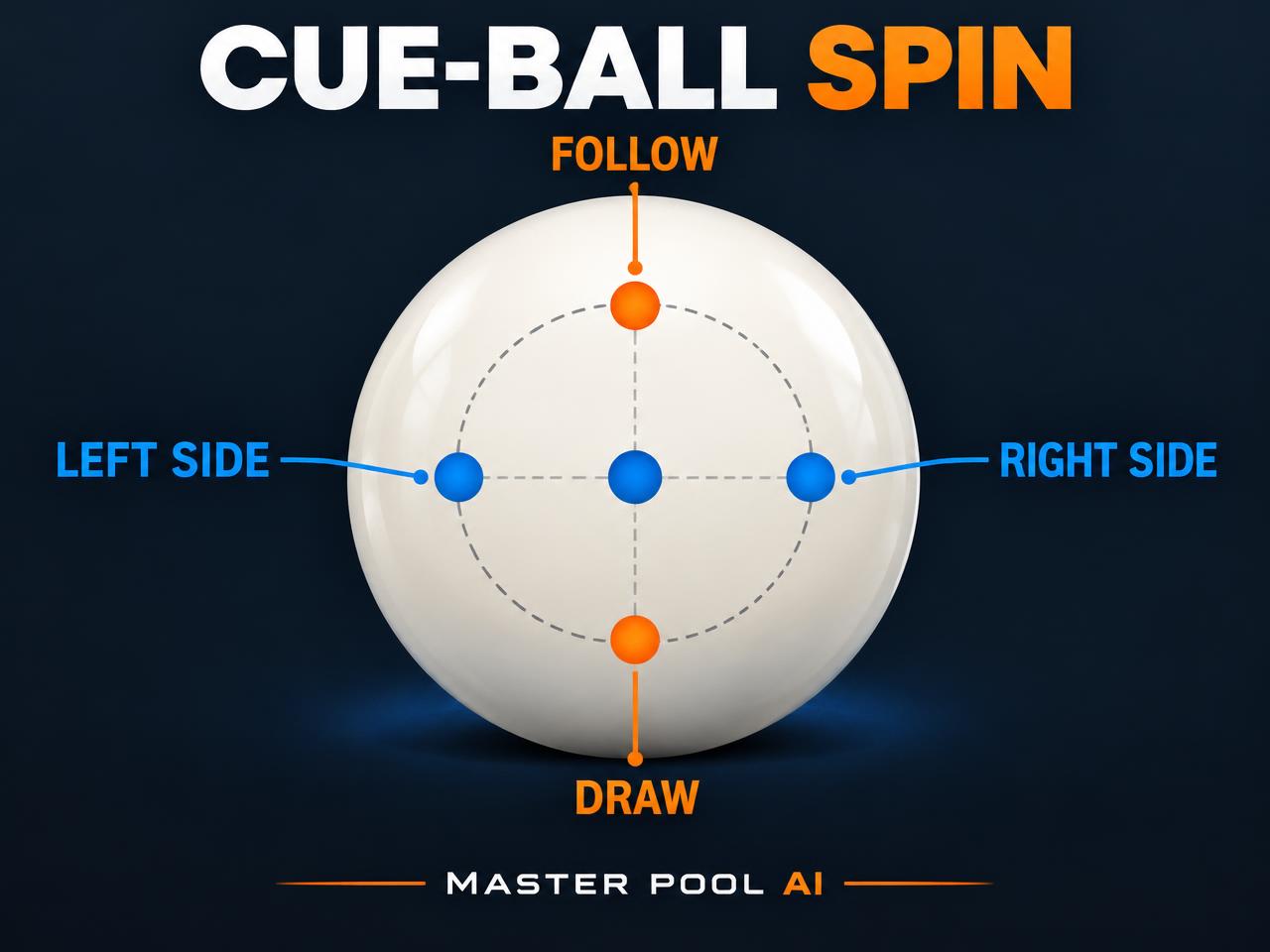
Follow means forward rotation at impact; draw means backspin at impact. Stun means little forward/back rotation at impact. A stop shot is the full-hit result of stun. Center-ball contact is a tip location, not a guarantee of stun: cloth friction can turn a sliding ball into a rolling one before contact.
A low hit may arrive as stun or roll if backspin wears off. On a cut, a stunned cue ball travels along the tangent line rather than stopping dead.
Real-table practice
From a short straight-in layout, play five stop, five follow and five draw shots. Then increase cue-ball distance and repeat; adjust speed and tip height to recover the same impact state.
Plan the cue-ball route
Plan the cue-ball route
Drawn on a 2:1 regulation bed with true 2¼-inch balls. Routes are conceptual; read the conditional angle rules below.
With equal balls and stun at contact, the cue ball initially leaves along the tangent line, approximately 90° to the object-ball direction. For a naturally rolling cue ball and roughly quarter-to-three-quarter hits, the departure is often about 30° from the incoming cue-ball direction. These angles use different reference lines.
Thirty degrees is an approximation, not a rule for all cuts. Full hits, very thin hits, speed, draw/follow and real-table effects change the route. Choose a landing zone away from pockets and blockers before getting down.
Real-table practice
Mark a half-ball cut with a clear landing zone. Compare five stun and five natural-roll shots at controlled speed. Record the route and finish point. Then choose a second-ball target and repeat with a realistic position goal.